
One Piano for Three: Learning Together
A different way to start learning the piano
Instrumental lessons have traditionally followed a familiar model: one teacher, one pupil, one instrument. One-to-one teaching offers valuable personal support and allows the teacher to adapt advice, posture and progress to each pupil. But throughout my years of teaching, I kept coming back to one question: what would happen if several beginners learnt together from their very first lessons?
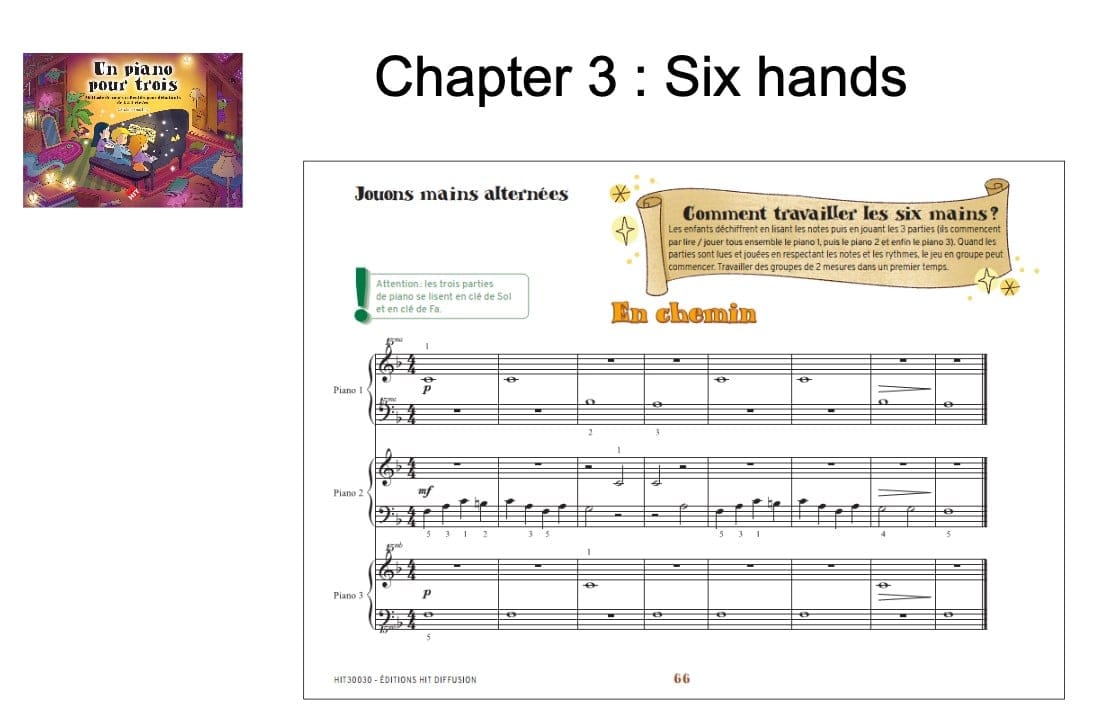
That question led me to create One Piano for Three, a method in which three young beginners share one keyboard — one in the upper register, one in the middle and the third in the lower register — and follow the same learning sequence. The aim is not simply to organise a group activity. I wanted to find out whether learning together could help each pupil become more independent when alone with their music and instrument. Individual and group teaching do not need to be set against one another. Each can bring something to the other.
Learning by watching others
In a one-to-one lesson, the teacher explains, demonstrates and corrects. In a small group, pupils also learn from one another. When a child is not playing, they are not simply waiting for their turn. They can watch where another pupil places their fingers, check that the hand stays comfortably rounded, hear a hesitation or a wrong note or rhythm, and see how the problem is solved. They also hear the same instruction more than once and see it used in slightly different situations.
From a lesson: when a new rhythm or note is introduced, a pupil will often play the passage correctly on their very first turn, simply because they took the time to watch and listen carefully to their classmates a few moments earlier.
Explaining something helps a pupil understand it
An idea often becomes clearer when a pupil has to put it into their own words. Once a child has understood an instruction or a keyboard landmark, they may explain it to a classmate in their own way. Another child’s words can sometimes make more immediate sense than the teacher’s. The pupil doing the explaining benefits too: they have to work out what really matters and, in doing so, check that they have understood it themselves.
From a lesson: one pupil was struggling to locate F in the middle register and was unsure where to place their hand. Before I intervened, a classmate showed them a visual landmark using the group of three black keys in the centre of the keyboard. The difficulty was resolved immediately and the group was able to resume the piece.
Each pupil has a role in the group
Playing music together gives children a sense of individual responsibility from the very beginning. When three pupils play together, everyone can hear the effect of what each person does: if one loses the pulse, the other two are unsettled; if someone comes in a beat too early or too late, the whole piece is affected; if one pupil stops listening, the ensemble becomes unstable. Responsibility is no longer just something the teacher asks for. It comes from a real musical need: “the others need me if the music is to sound right”. It is rather like a team sport: everyone has a role, but must keep listening and adapting to the others.
What do the first lessons look like?
To offer teachers something they can use straight away, here is the teaching sequence followed during the first group lessons with One Piano for Three.
Putting a group together
I try to bring together children of a similar age: for example, three seven-year-olds, which is the age at which I recommend beginning the piano. With older children, a gap of one or two years matters less. From the age of eight, they are generally mature enough for the group to work well together.
Stage one — Exploring the keyboard and finding a place to play
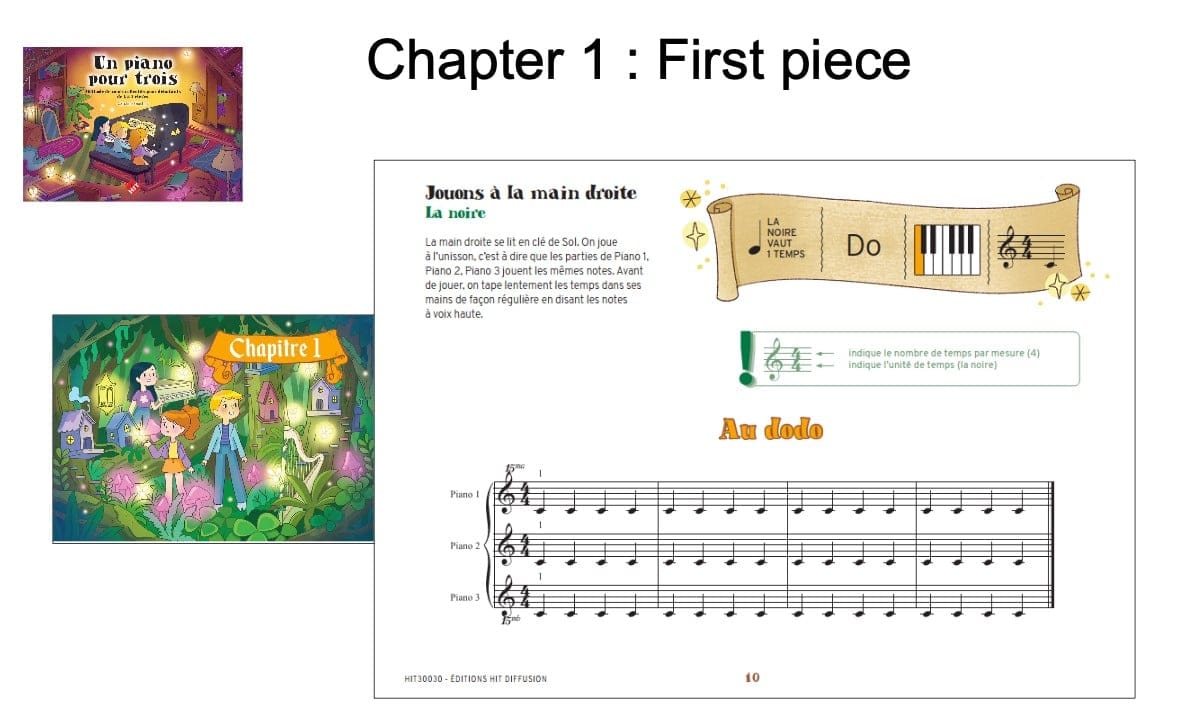
The three pupils sit at the keyboard, in the lower, middle and upper registers. At this first stage, they read the same notes in different registers: Piano 1 plays two octaves higher, Piano 2 plays in the middle register at written pitch, and Piano 3 plays two octaves lower. They discover their first visual and aural landmarks, then learn to find the same notes in several octaves. From the opening minutes, the children explore the whole keyboard, from bass to treble, and learn to find their way around it.
Stage two — First rhythmic landmarks and first notes
The pulse and the first note values are introduced. Before playing a piece, the pianists always follow the same routine: they read the notes aloud in rhythm while beating the pulse — we call this “solfège” — and always count a full bar in before they begin.
Stage three — Listening actively to the pupil who is playing
One pupil volunteers to play their part so that the others can discover the melody. While they play, the other two say the notes aloud and in rhythm. Listening therefore remains active, together with the simple feeling that “we are encouraging our classmate while they play”.
Stage four — All three pianists play together
After these stages, all three pianists play the piece together, still taking care to count before beginning. The first elements of reading — notes and rhythm — are therefore connected directly to playing. Progress is deliberately slow, allowing each idea to be absorbed. The pieces begin in unison, to secure the pulse and reading, before polyphony is introduced gradually.
Stage five — From collective learning to individual work
Collective discovery → Group playing → Individual application → Independence
Through collective discovery, pupils learn the notes, rhythms, dynamics and phrasing. A “work at home” symbol, represented by a house, then shows each pupil what to revise independently.
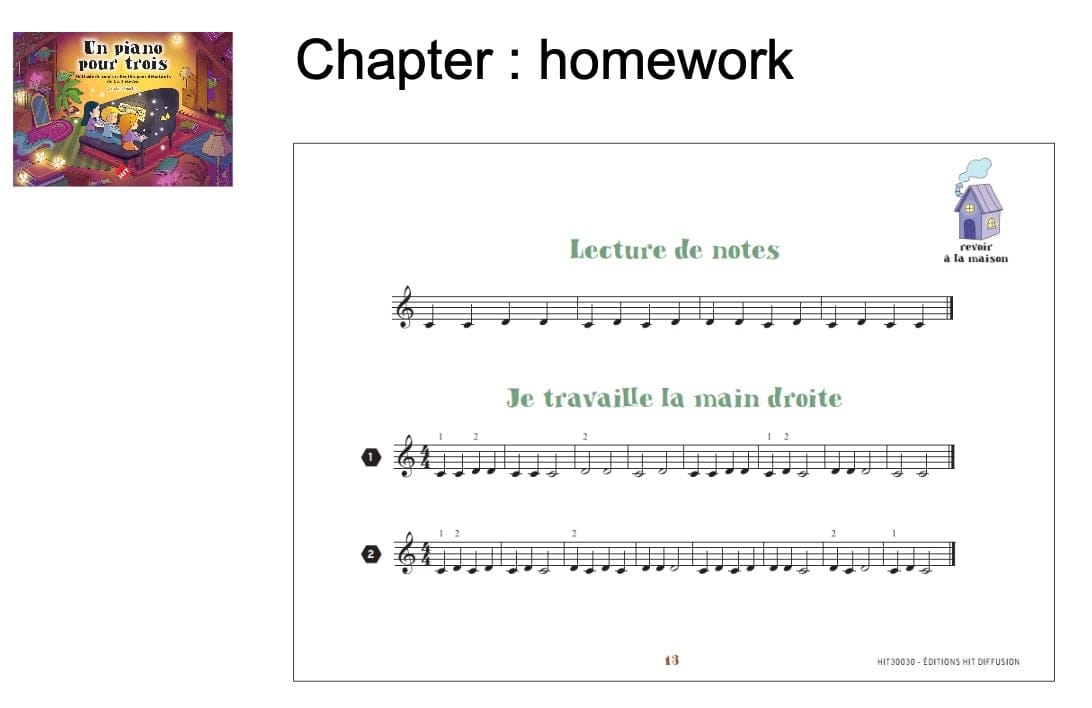
This work always follows the same routine: read the notes in rhythm before playing, then play slowly and steadily, saying the notes aloud and keeping strictly in time.
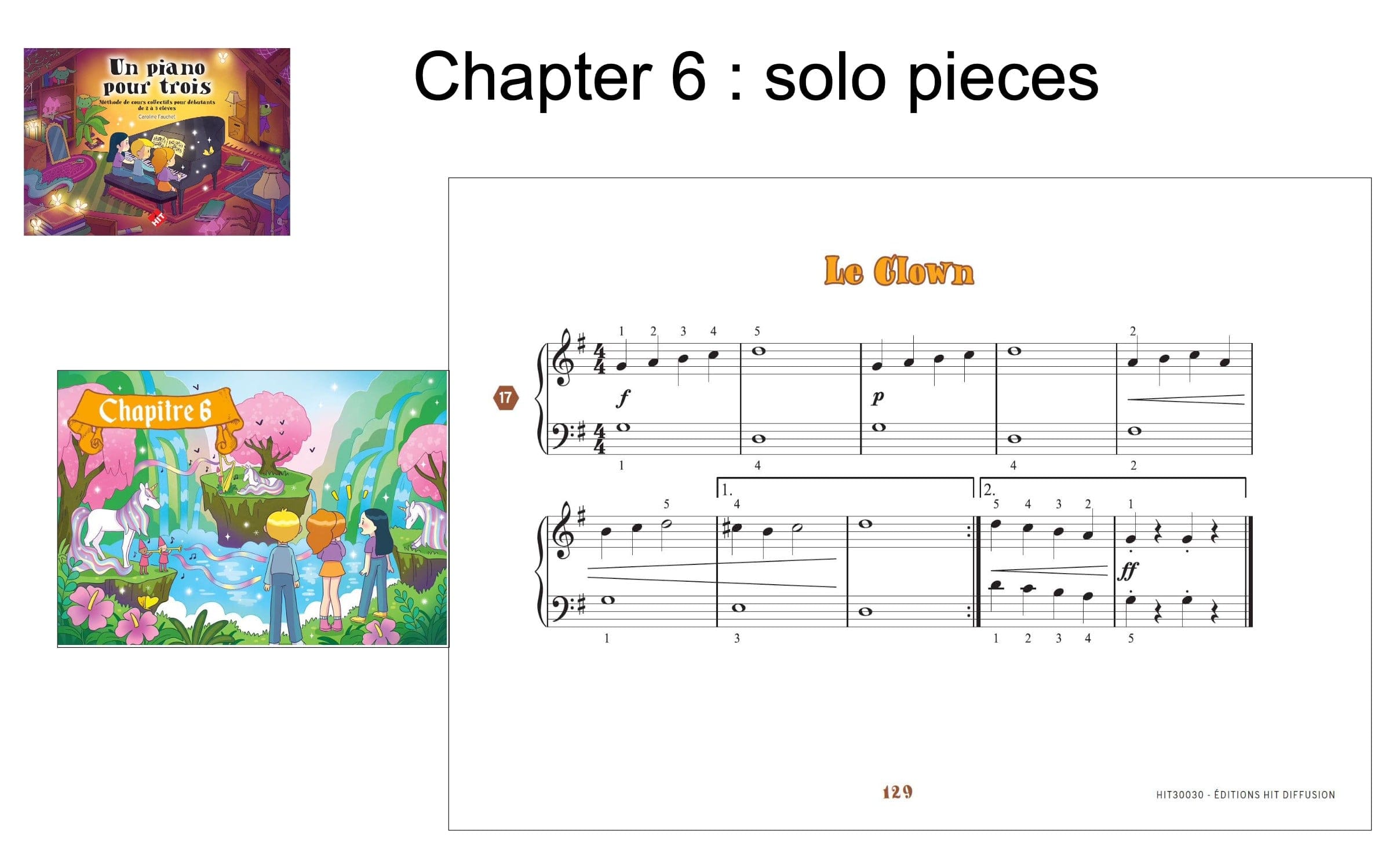
To enable the children to apply independently what they have learnt together, another symbol — a firefly — directs them to Chapter 6, which contains individual pieces. The pupil can then work independently while retaining the tools and habits developed in the group.
One shared sequence, three different pupils
I try to keep the three pupils moving forward together, using the same material and following the same sequence. When one child gets stuck, I change the way I explain the idea. The group can also help through listening, talking or watching a classmate. Once the difficulty has been resolved, the three pupils carry on together.
From a lesson: while learning to pass the right thumb under, one pupil watched a classmate’s demonstration closely before realising that they had been making the movement in the opposite direction. The classmate explained the movement and gently guided the pupil’s hand to show how the thumb passes under the index finger, rather than over it. This spoken and visual explanation removed the obstacle, allowing all three pupils to resume the piece together.
The teacher’s role changes too
Teaching a group does not mean giving three individual lessons simultaneously. Yet this is exactly what I tended to do at the beginning of my career, when a director asked me to teach a group of three pupils. The teacher is no longer the person who supplies every answer: they guide the exchanges, encourage pupils to search together and gradually help them to find their own solutions.
Above all, the teacher has to learn to watch before stepping in: to notice how the children listen and respond to one another, who helps whom, and also which pupil is following the group without really understanding. I encourage them to explain what they are doing and to talk about their successes as well as their mistakes. Most importantly, I sometimes have to resist intervening straight away and give the group a few seconds to search, try, make mistakes and eventually find a solution.
A change in my own teaching: after years of individual teaching, in which I was used to correcting every mistake immediately, I had to learn to step back and give pupils more time. Not intervening at once, allowing a question to emerge, and giving children the opportunity to search together, listen to one another and sometimes correct each other: this is another way of teaching, and one that I have developed gradually.
Learning together so that each pupil can play alone
The aim is not for pupils to become dependent on one another. Quite the opposite: they learn together so that, little by little, they can play alone. If a pupil no longer knows what to do as soon as their classmates stop, they are not independent yet. New ideas are therefore first discovered, tried out and discussed together. Then each pupil has time alone with the instrument, particularly through the individual pieces.
These pieces show what the pupil has really understood and what they can do on their own. The group is there to help, support and build confidence, but it should gradually become less necessary. Moving from group work to individual playing is what helps the child become independent.
Ideas that any teacher can use
A teacher does not have to work regularly with three pupils at one piano to use some of these ideas. They can also be brought into one-to-one teaching: occasionally bring two or three pupils together; invite one to listen while another plays, then ask what they noticed; ask one pupil to explain an idea to another; make more use of duet playing and listening; or ask a pupil how they practise a difficult passage.
Sometimes the difference is only a few seconds: letting the pupil search before giving the answer. We have to learn not to take that moment away. These are simple changes, but they can already affect the way a pupil learns and builds confidence.
Conclusion
Learning together and becoming independent are not opposing aims. A small group teaches the child to listen, observe, explain, make choices and gradually develop confidence in their own abilities. This way of working is not limited to the piano either. Any instrumental teacher can use some of these ideas without completely changing the way they organise their lessons.
I notice this even in the individual pieces. The children become so accustomed, when playing as a group, to counting before they begin and saying the notes aloud that they continue to do so spontaneously when playing alone. I then have to tell them: “Now you can count and say the notes in your head.”
Perhaps this is where I see most clearly what collective learning has given them: when they find themselves alone at the piano, the others are no longer there, but the working habits they built together have remained.
By Caroline Fauchet
Caroline Fauchet is a French concert pianist, piano teacher and author of music education methods. After studying at the Conservatoire de Saint-Germain-en-Laye, where she won two gold medals in piano and chamber music at the age of 14, she continued her studies at the École Normale de Musique de Paris in the class of Germaine Mounier. She later earned the French Diplôme d’État in piano teaching at the Cefedem Île-de-France. A prizewinner at several competitions, including second prize at the Sofia International Competition and the Albert Roussel Interpretation Prize, she pursues an active concert career and has released several recordings.
She has taught in the Paris region since 2003, and her teaching work has also taken her to universities in the United States and Scotland. Her methods are published by Hit Diffusion-Billaudot and Soldano Editions. Her piano method One Piano for Three is designed for three beginner children sharing one keyboard, combining collaborative learning with the development of individual independence.
One Piano for Three book (English version available soon): Billaudot
Originally published on the ISM website.