
Piano Teaching in the UK Today: How the Way We Learn and Teach Is Evolving
Piano teaching in the UK is changing, but not in the simple way that people sometimes imagine. The future is not a choice between tradition and technology, between exams and creativity, or between the private lesson and the group classroom. The most interesting development is more human: teachers are becoming better at combining structure with curiosity, discipline with flexibility, and high musical standards with a clearer understanding of how different learners grow.
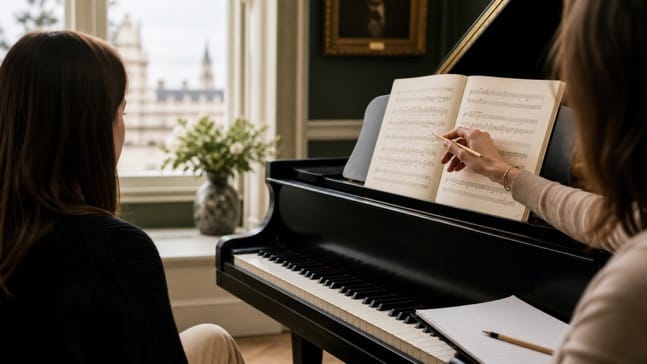
For pianists, this matters deeply. Piano study has always asked for patience. It still requires tone, rhythm, reading, listening, memory, hand organisation and the slow courage of repeating a passage until it begins to speak. What is different today is the environment around the lesson. Children arrive with digital habits, busy timetables and uneven access to school music. Adults arrive with serious musical wishes but limited time. Teachers must therefore do more than assign pieces. They must design a learning route.
A profession moving beyond the old model of weekly correction
The old caricature of piano teaching was simple: a student practises alone all week, arrives at the lesson, plays, receives corrections, and repeats the cycle. Good teachers have always done more than this, of course. But today the expectation is becoming more explicit. A lesson is not merely a place where mistakes are identified. It is a place where practice itself is taught.
That shift is visible across many forms of modern piano education. A teacher may still work from a classical score and prepare a student for graded exams, but the lesson is increasingly likely to include short practice diagnostics, listening tasks, rhythm games, body-awareness work, recording feedback, duet playing, improvisation or guided questions about how the student hears a phrase.
This does not make teaching softer. In many ways it makes it more rigorous. If a student only knows that a bar is wrong, the teacher has diagnosed a symptom. If the student understands why the bar keeps failing, fingering, pulse, tension, reading, sound imagination or memory, the lesson has built independence.
Access, school music and the private lesson ecosystem
The UK discussion around music education is shaped by access. The Department for Education’s National Plan for Music Education, The Power of Music to Change Lives, sets out a vision that children should be able to sing, play, create and progress musically. Arts Council England’s Music Hub structure also places emphasis on local partnerships that support high-quality music education for young people.
Yet the public conversation also recognises pressure. Parliamentary and sector commentary continues to point to uneven school provision, declining entries in some advanced music qualifications, and the risk that sustained instrumental learning becomes easier for families who already have cultural and financial resources. Piano teaching sits at the centre of that tension. It can be private, individual and highly specialised; but it can also be a route into confidence, literacy, listening and long-term cultural participation.
This is why the relationship between school music, music hubs, conservatoires, private studios and independent teachers matters. The healthiest ecosystem is not one in which each part works separately. A child may first meet music through school singing, discover keyboard patterns in a group class, then develop deeper technique in one-to-one tuition. An adult may return to piano after years away because a concert, a recording, or a child’s lesson reawakens curiosity.
Why face-to-face teaching still matters
Digital resources have improved dramatically. A student can now slow down recordings, annotate scores on a tablet, film a practice session and access more repertoire guidance than any previous generation. Used well, these tools can support listening and accountability. Used badly, they can create the illusion that information is the same as learning.
Piano playing remains physical, acoustic and relational. The teacher hears the difference between a note played loudly and a note played with supported tone. The teacher notices when the wrist is locked, when the student is holding breath, when the pulse is insecure, or when a phrase has been memorised mechanically rather than musically. These details are often too subtle for a general tutorial video.
That is why the strongest UK studios are not abandoning in-person teaching. They are refining it. In London, for example, established schools such as WKMT continue to demonstrate the value of face-to-face piano lessons in London for students who need real-time musical feedback, structured progression and a serious teaching environment. The point is not that every lesson must be traditional. The point is that embodied musical judgement still needs a teacher in the room.
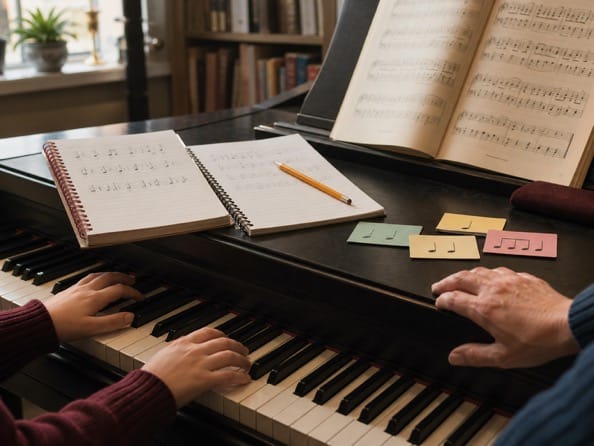
The learner is changing: children, adults and returning pianists
One reason piano pedagogy is evolving is that the student profile is broader than before. Teachers now meet very young beginners, teenagers balancing exams and screens, adults who regret giving up, advanced amateurs who want deeper repertoire, and professionals who need technical or interpretative refinement.
Children often need lessons that make practice visible. They benefit from clear, short tasks: clap this rhythm, sing this phrase, find the pattern, play the left hand as quietly as possible, circle the place where the hand changes shape. The teacher’s role is to convert effort into something the child can understand.
Adults need something slightly different. They often bring taste, discipline and emotional investment, but also self-criticism. A good adult lesson respects maturity without assuming prior skill. It explains the reason behind technical work, connects repertoire to listening, and gives practice strategies that fit around work and family life.
Returning pianists can be the most interesting group of all. They remember music in fragments. The fingers may not obey, but the ear remembers colour, phrase and style. Teaching them well requires tact: enough structure to rebuild foundations, enough musical richness to avoid making the return feel like punishment.
Group teaching and shared learning are becoming more sophisticated
The rise of group and paired piano formats is not simply a cost-saving measure. At its best, shared learning can build rhythm, listening, confidence and social musicianship. Students hear each other’s solutions. They learn to wait, to accompany, to copy, to compare and to perform in a low-pressure setting.
This connects naturally with Caroline Fauchet’s pedagogical work. Her public teaching profile presents a structured and enjoyable approach for children, adults and professional learners, and her news pages have highlighted her interest in collective piano methods, including work around teaching several learners at one keyboard. That kind of experimentation is part of a wider pedagogical question: how can piano, historically associated with solitary practice, become more socially intelligent without losing technical seriousness?
The answer is not to replace one-to-one teaching. It is to use different formats for different aims. A child may build rhythm and confidence in a group, then refine touch and reading individually. An adult may enjoy a workshop for musical context but need private guidance for technique. The best teachers are becoming format-aware.
Safeguarding and professionalism are now part of musical quality
Another important change is that professionalism in teaching is no longer judged only by musical knowledge. Safeguarding, communication, appropriate boundaries, clear lesson policies and transparent contact with parents are central to trust.
The Musicians’ Union safeguarding code of conduct makes this explicit for music education contexts, including private studios, schools, workshops and online lessons. It covers professional behaviour, communication, record keeping, consent around images or recordings, DBS expectations in England and Wales, and safer lesson environments.
This matters for piano because the lesson is often individual and personal. A student may be alone with a teacher for a long period of time, sharing frustration, ambition and vulnerability. The modern teacher must therefore create not only musical progress, but a safe frame for that progress.
Exams remain useful, but they no longer define the whole journey
Graded exams still have a valuable place in UK piano culture. They offer repertoire structure, external milestones and a common language for progression. ABRSM’s continuing piano syllabus work shows how deeply embedded this framework remains.
But the best current teaching treats exams as one tool rather than the destination of music. A student can prepare for a grade and still learn to improvise. A child can pass an exam and still need help listening to tone. An adult can avoid exams altogether and still study Bach, Chopin, Debussy or contemporary repertoire seriously.
This balance is one of the healthier signs in UK piano pedagogy. Teachers are becoming more willing to ask: what does this learner actually need next? Sometimes the answer is a scale. Sometimes it is a concert. Sometimes it is a simpler piece played beautifully. Sometimes it is a week spent learning how to practise two bars properly.
Technology is useful when it serves attention
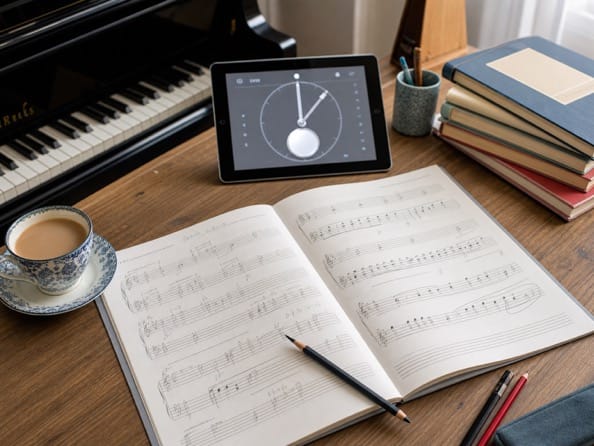
The strongest use of technology in piano teaching is not novelty. It is attention. A recording can reveal whether tempo is steady. A digital score can help annotate layers quickly. A video exchange can support a student between lessons. A metronome app can make pulse visible. Online lessons can maintain continuity when travel is impossible.
The weakness of technology is that it can make learning feel fragmented. Students may collect tips without building habits. Teachers therefore need to curate technology rather than simply add it. The question should always be: does this tool help the student listen, move, remember, understand or practise better? If not, it is decoration.
What the next phase of UK piano teaching should protect
If piano teaching in the UK is evolving well, it should protect five things.
- Serious musicianship: tone, rhythm, reading, phrasing and stylistic understanding.
- Access: more routes into piano for children and adults who may not see themselves as musical people.
- Teacher professionalism: safeguarding, communication, boundaries and ongoing development.
- Intelligent use of formats: one to one lessons, group teaching, workshops, online support and performance opportunities used for the right reasons.
- The joy of sound: the reminder that piano study is not only assessment, but a way of listening more deeply.
The future of piano teaching is therefore not a rejection of the past. It is a better reading of it. The best traditions of piano pedagogy, discipline, craft, attentive listening and respect for the score, are still essential. What is changing is the teacher’s awareness of how learners arrive at those values.
A good piano lesson today should leave the student with more than corrected notes. It should leave them with a clearer ear, a more intelligent practice plan, and a stronger sense that music is something they can enter with patience and dignity. In that sense, UK piano teaching is not merely adapting to the times. At its best, it is becoming more complete.